EMBEDDED XWDM: SIMPLE. EFFICIENT. EFFECTIVE.
For companies with access to a dark fiber network, embedded xWDM is a simple and efficient method of transporting multiple storage and data services between sites. It has the simplicity of a single channel extended longwave laser (ELWL) approach but is able to transport many traffic signals over a single dark fiber.
The ELWL transceiver is replaced by a CWDM or DWDM transceiver which is connected directly into the host switch. Instead of connecting onto the line fiber, these xWDM signals are connected by a patch cable to a passive multiplexer which gathers them together and transports them over a single dark fiber link.
Passive optical networking the Smartoptics way
The need to transmit data grows with every new department, new service, new communication application, new security requirement. Increases that can buckle existing systems. That’s one reason companies seek to upgrade their fiber networks. Laying new fiber optic cable can be prohibitively expensive. And so is adding “one off” services through leased or managed services. Expanding network capacity with Smartoptics is easy with plug and play solutions that are far less costly to own and run.
- Replace the ELWL transceiver with a “colored” C/DWDM transceiver

- Add as many SAN and/or IP channels as required just by adding additional transceivers
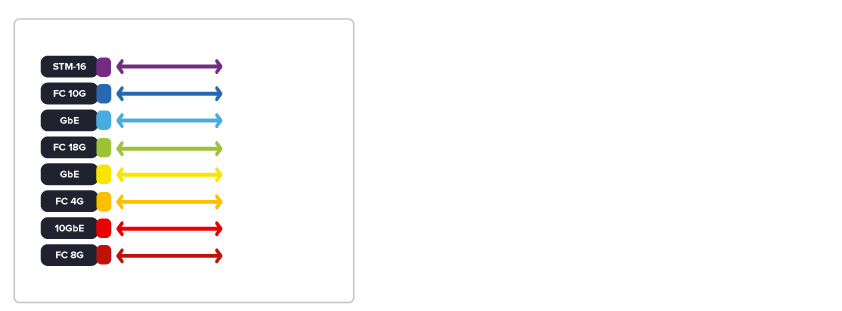
- Use an LC cable to connect the output of the transceiver to the corresponding channel on the multiplexer. Make sure cables and connectors are thoroughly cleaned.
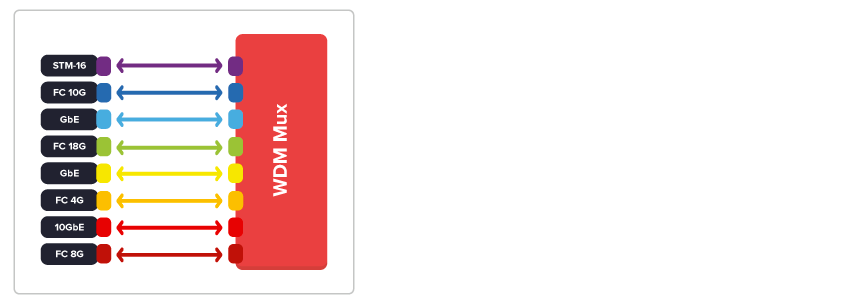
- Connect the line port on the multiplexer to the dark fiber. Do the same at the other site.

Passive networking. The cost is a fraction of an active system and frees up initial investment and maintenance that can be spent in other areas of the network. With an embedded xWDM system there is no noise, fans, emissions, resulting in a green data center network. Networking as it should be – simple and cost effective.
Learn how using WDM will expand your network’s capacity
Wavelength division multiplexing, WDM, has long been the technology of choice for transporting large amounts of data between sites.
Related articles

When the on-ramp to the core becomes the bottleneck
Simplified DWDM vs. traditional DWDM: balancing architectures and use cases